旅行日誌
Explore Dominican tobacco farms in La Canela: planting, harvesting, air curing, fermentation, and how premium cigar leaves develop their character.
發佈於
Plan your cigar trip to Santiago de los Caballeros with factory tours, cigar lounges, events, restaurants, hotels, and local experiences curated by Boca2Boca.
In the countryside around La Canela, near Santiago de los Caballeros, tobacco is more than a crop. It is part of the agricultural knowledge behind the Dominican Republic’s premium handmade cigar industry. Rows of broad green leaves, carefully tended seedbeds, and tall curing barns tell the story of a product that takes months of fieldwork and additional time in processing before it can become a finished cigar.
The most revealing place to understand this transformation is often not the rolling table but the tobacco farm itself. The aroma, texture, combustion, and character of a cigar begin with decisions about seed, soil, shade, irrigation, harvesting, and the treatment of each leaf after it leaves the field. This guide follows that journey, with a special focus on traditional air-curing barns, known locally as ranchos de secado.
The Cibao Valley is a historic center of Dominican tobacco cultivation and cigar manufacturing. Agricultural communities around Santiago, including La Canela and nearby growing areas, connect farmers, leaf buyers, processors, and cigar makers. Not every tobacco farm produces the same type of leaf: varieties, cultivation methods, and intended uses differ among growers and seasons.
The broader Dominican tobacco industry also uses leaf from other Dominican growing regions and imported origins. A premium Dominican cigar may combine tobaccos from several countries. Understanding the farm is therefore not about claiming that one field supplies every cigar, but about seeing how one crucial part of a complex supply chain works.
Tobacco begins as a tiny seed, typically started in protected seedbeds or trays where young plants can establish roots before transplanting. Growers monitor moisture, temperature, disease pressure, and seedling development. Once the plants are sufficiently established, they are transferred to prepared fields with appropriate spacing for the variety and cultivation system.
In the Dominican Republic, planting and harvesting calendars vary with the region, weather, farm practices, and crop. The main field season commonly falls within the cooler and relatively drier part of the year, but visitors should never assume that mature plants, active harvesting, or full barns will be visible on a particular date. A farm visit in one month may show seedlings; in another, workers may be harvesting or tending curing leaf.
Sun-grown tobacco develops under direct sunlight, while shade-grown crops are cultivated beneath protective cloth or other shade structures. Shade can change leaf development, thickness, surface characteristics, and handling requirements. The choice depends on the desired tobacco type and intended use, particularly when a grower is targeting wrapper-grade leaf.
Wrapper, binder, and filler are roles in cigar construction, not three interchangeable farming techniques. Wrapper leaves are selected for appearance, elasticity, integrity, and suitable smoking qualities. Binder must hold the bunch together; filler contributes much of the cigar’s blend and burn. The same agricultural origin does not guarantee the same final classification, because grading and processing matter.
Successful cultivation requires careful management of soil conditions, nutrition, drainage, irrigation, pests, and plant growth. Some growers remove flowers through topping and manage suckers to direct plant resources toward the leaves. These practices depend on the tobacco variety and production objective.
Leaf position matters. Lower leaves generally receive different light and mature differently from leaves higher on the stalk. Cigar makers often use terms such as volado, seco, and ligero to describe functional leaf classes associated with burn, aroma, and strength, although exact classification and terminology vary by producer. A leaf’s final smoking character is influenced by genetics, growing conditions, position, harvest maturity, curing, and later processing—not simply its height on the plant.
Many premium cigar tobaccos are harvested by priming: workers remove leaves progressively as they mature, often starting lower on the plant and returning for later passes. Other tobacco types or operations may use different harvesting methods. Timing is important because immature, mature, and overmature leaves can behave differently during curing and fermentation.
Harvested leaves must be handled gently. Tears, bruising, contamination, and careless stacking can reduce quality, especially for leaves intended for wrappers. Workers move the fresh crop toward the curing barn as promptly and carefully as local conditions require.
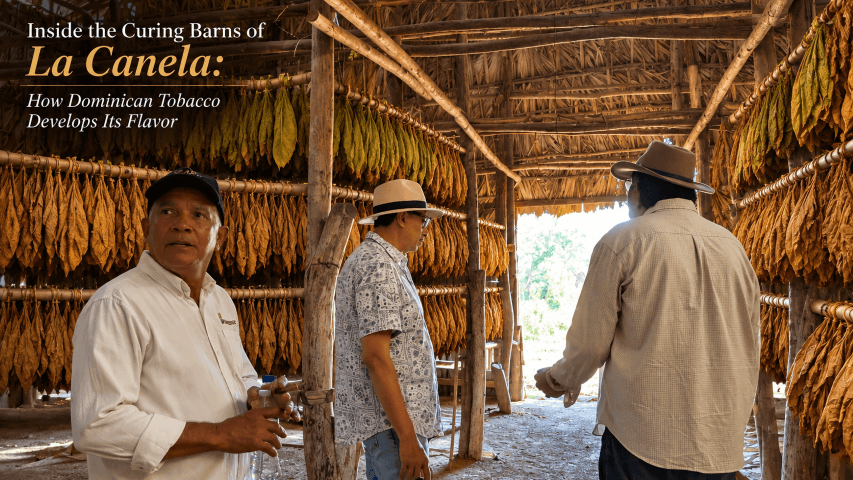
A traditional curing barn is an agricultural processing space designed to let tobacco lose moisture gradually under managed ventilation and humidity. In the Cibao countryside, ranchos de secado may be built from timber and other locally appropriate materials, with openings or panels that workers adjust as conditions change. Their appearance and construction vary from farm to farm.
Step inside an active barn and you may find long rows of suspended leaves shifting from green to yellow, tan, and brown. The smell changes over time as the crop cures. Rather than baking tobacco rapidly, air curing relies on a controlled progression of biological and physical changes. The goal is a properly cured leaf that can be handled, sorted, and prepared for subsequent processing.
After harvest, workers arrange tobacco on strings, poles, or other supports, depending on the farm’s equipment and tradition. In Dominican operations, the process may be called ensarte, and wooden poles are commonly known as cujes. Spacing is essential: leaves need airflow without being crowded or exposed to unnecessarily harsh drying.
The barn is loaded strategically. Workers consider the amount of tobacco, the distribution of air, the stage of curing, and local humidity. A visitor watching ensarte is seeing a skilled manual process, but not every farm uses identical tools or layouts.
During early curing, leaves gradually lose their vivid green appearance as chlorophyll degrades and other biochemical changes take place. Yellowing can take several days or longer depending on the crop and barn conditions. The leaf remains biologically active for part of this period; drying too aggressively can interrupt desirable changes.
A grower’s challenge is balancing moisture retention with sufficient ventilation. Excessive dryness can create brittle or unevenly cured leaf, while prolonged dampness may encourage mold or deterioration. Yellowing is a stage to manage, not a stopwatch that every leaf follows identically.
As curing progresses, leaves turn from yellow toward tan and brown. Moisture continues to decline, and the leaf’s chemistry evolves. Ventilation openings may be adjusted in response to rainfall, wind, temperature, and humidity. The farmer is managing the environment, not directly programming a specific flavor note.
Color alone does not prove that tobacco is ready. Workers assess the condition of the leaf blade, its consistency, and the progress of drying. Different leaves and positions in the barn may require different amounts of time.
The thick central vein, or midrib, generally takes longer to dry than the thin leaf blade. Completing this stage helps prevent moisture problems during storage and transport. Once curing is finished, tobacco may need conditioning—carefully reintroducing enough moisture to make the leaves pliable for handling without creating excessive dampness.
Workers can then take down the leaves and organize them into bundles for sorting and subsequent processing. Local terms and bundling methods vary; the key distinction is that tobacco leaving the curing barn is not automatically ready to be rolled into a premium cigar.
Air curing often takes roughly four to eight weeks, and sometimes longer, depending on leaf type, weather, barn design, loading density, and management. A commonly cited window of 45 to 60 days can be useful as an illustration, but it is not a universal rule. A humid spell can slow drying; a different tobacco variety may behave differently in the same barn.
For visitors, the practical lesson is that curing is a living process. A barn can contain leaves at several stages, or it may be empty between harvests. The exact scene depends on the agricultural calendar rather than the tour schedule.
Curing is the initial controlled drying and transformation of freshly harvested leaf. Fermentation is a later processing stage, often carried out with conditioned tobacco assembled in carefully monitored piles or pilones. Under appropriate moisture and temperature conditions, chemical and microbial activity helps modify the tobacco’s character. The methods, duration, and intensity vary widely by producer and leaf type.
Workers monitor internal pile temperatures and may turn or rebuild the piles to manage heat and ensure more even processing. Excessive heat or poor moisture management can damage tobacco. Proper fermentation can reduce harshness and certain undesirable compounds, while helping develop a more integrated aroma and smoking profile. It does not guarantee a specific flavor such as chocolate, cedar, or coffee.
Following fermentation, tobacco is typically rested or aged under managed storage conditions. Aging allows the leaf to stabilize further before it is used in a blend. Time requirements depend on the type of tobacco, producer standards, and intended cigar; longer is not automatically better.
Leaves are also sorted and graded according to characteristics such as size, color, texture, integrity, and suitability for wrapper, binder, or filler. Some tobacco is stripped or deveined at an appropriate stage. These decisions determine how a crop is used commercially and how consistent the final cigar can be.
Cigar flavor is not created in one barn or by one single chemical reaction. Genetics establish a starting point. Soil, climate, water, nutrition, light exposure, plant health, and harvest maturity influence the harvested leaf. Curing then changes moisture and leaf chemistry; fermentation and aging further shape its smoking properties. Finally, blending, rolling, and storage influence the finished experience.
Descriptions such as cedar, earth, nuts, spice, hay, cocoa, or sweetness are tasting impressions, not proof that those ingredients were added to the tobacco. Different smokers may perceive the same cigar differently. A farm visit makes these distinctions easier to understand because visitors can compare the appearance and aroma of tobacco at different stages before it becomes a finished product.
Once processed and graded, tobacco reaches cigar manufacturing operations where blenders select compatible leaves and rollers construct the bunch, apply the binder, and finish the cigar with a wrapper. Factories may inspect draw, weight, appearance, and construction according to their own quality-control standards. Finished cigars are often rested before packaging or distribution.
This is why a tobacco farm and a cigar factory tell complementary stories. The farm reveals agricultural choices and the transformation of green leaves; the factory shows how carefully selected, processed leaves become a consistent handmade cigar. Seeing both can provide a more complete understanding than either visit alone.
A farm experience may include a walk through planted fields, an explanation of seedbeds and cultivation, a look at curing structures, and a conversation with growers about harvest timing and leaf handling. What is available depends on the farm, season, weather, and operational permissions. During an active curing period, visitors may see hanging leaves or workers adjusting the barn; at other times, a guide may explain the process using the facilities and available examples.
Ask about the actual itinerary before booking. Farm access, a curing-barn visit, demonstrations, tastings, factory stops, transportation, lunch, and lounge sessions are separate inclusions unless specifically confirmed. Agricultural sites are working environments, and certain areas may be restricted for safety or to protect the crop.
For travelers hoping to see living plants or harvesting activity, the growing and harvest season generally offers more possibilities than the off-season. In the Santiago region, the cooler months are often especially relevant, but timing varies from farm to farm and from year to year. Curing may continue after leaves have been removed from the fields, so an active barn does not necessarily mean harvest is happening that day.
If you are traveling specifically to photograph seedlings, mature plants, harvesting, or barns full of curing leaves, request confirmation of current conditions. Do not assume a particular agricultural stage will be available simply because a tour is advertised.
Wear comfortable closed-toe shoes, bring water and sun protection, and expect uneven ground. Follow your host’s directions around equipment, hanging tobacco, and storage areas. Avoid touching leaves or opening ventilation panels without permission; moisture control and leaf integrity are part of the farmer’s work.
Photography policies differ. Ask before photographing workers or restricted production areas, and respect the grower’s time. Visitors who want a technical explanation of varietals, priming, curing, fermentation, or blending should mention those interests in advance so the appropriate host can be requested.
Usually not. Curing takes place in agricultural facilities such as ranchos de secado, while fermentation, sorting, aging, and cigar manufacturing may occur in separate facilities. Some integrated producers manage multiple stages, but the processes remain distinct.
Cured leaf is not generally ready for premium cigar production. It normally requires additional conditioning, sorting, fermentation or other processing as appropriate, and aging before it can be selected for a blend.
No. Wrapper tobacco may be produced using different cultivation methods and sourced from different origins. Shade growing is one technique used for certain leaf characteristics, not a universal requirement for every wrapper.
No single stage produces those impressions by itself. Flavor and aroma emerge from the interaction of genetics, cultivation, curing, fermentation, aging, and blending. Tasting notes are sensory descriptions, not literal ingredients.
Potentially, yes, if a farm accepts visitors. However, fields, barns, and demonstrations may look different outside the active season. Confirm what is available for your travel date.
Boca2Boca helps travelers explore Dominican cigar culture through privately arranged experiences in the Santiago region. Depending on farm availability and the season, an itinerary may combine a tobacco farm visit with a small cigar factory, a rolling demonstration, or a lounge experience. Each itinerary should be confirmed individually rather than treated as a fixed list of guaranteed activities.
Tell us your travel date, group size, and whether you are most interested in cultivation, curing barns, fermentation, or cigar rolling. We can help you explore an itinerary that fits the agricultural calendar and available hosts. Visit Tobacco Farm Tour to inquire about a private Dominican tobacco and cigar experience.
發現精心挑選的商品以豐富此篇內容。
探索精選 Viator 體驗以豐富此篇內容。